
“You financially support your farmers, working at the cotton plantation, then you deliver us a worn clothing – said one of the Economist from Senegal about the campaign to collect clothes for the poor countries in rich countries. This sentence was an inspiration for our foundation workshop organized for youth named “How to help Africa in a smart way?”.
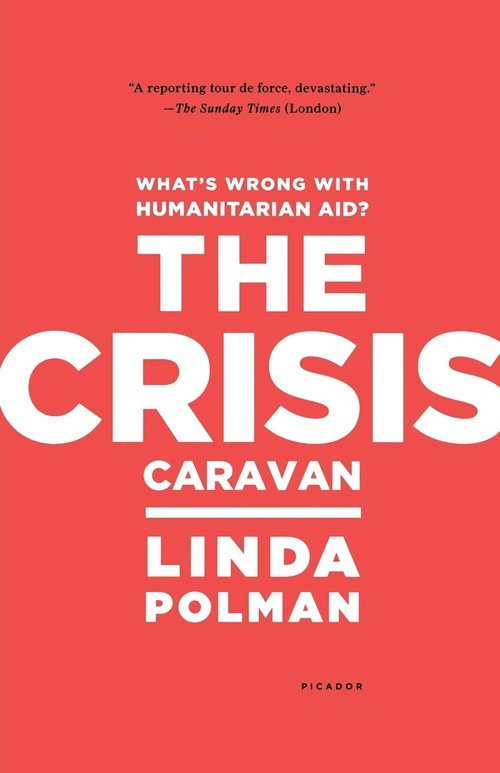
Senegalese economist in a Lindy Polman’s book also says: ““Wherever you find yourself in Africa, you get the impression that you’ve walked into a Salvation Army thrift store. We grow cotton in Africa but the West does not want to buy it.”

That quote just like in a contact lens comes with couple of errors, that are possible to make by those purely devoted volunteers (delivering ready-made products to Africa effectively stifles its development on many levels).
The fifth economic world power
Isn’t the catchy book title an overexaggeration? Well, if it comes to international aid range, it is not: “On the American University of John Hopkins it has been proven that if all the humanitarian organizations: non-governmental, national and international, from the local soup-kitchens to international organizations intervening during some serious crisis; formed a single nation, it would be the world’s fifth-largest economic power.
However, isn’t it harmful calling humanitarian aids an industry?
The absurdities of humanitarian aids, provided by Linda Polman are as long as kilometres of unimportant, numerous highways leading to nowhere, yet still build as part of aid projects. In my private tier list the winners are: airlifting drinking water from Europe and bringing asphalt to Africa. Furthermore, there are numerous similar examples in the book.
Aid for… America
Similarly to the situations of appalling waste, “about 70 to 80 percent of humanitarian aids funding, provided by United States government goes for: American organizations, manufacturers, construction companies and logistics companies. It is estimated that the prizes of Iraq restoration, which is one of the biggest humanitarian projects of America, could have been lower by even 90 percent if the reconstruction of roads, bridges, factories and power plants and water supply systems were delegated to the Iraqi executors rather than American entrepreneurs. Over half the entire American aid in Iraq is intended, exclusively for accommodation, costs of stay and protection for thousands of Americans arriving in Iraq to perform there their commissioned work.”

Aid as a weapon in a war
However, besides absurdities and enumerating appalling scams the author has some other concern. Polman also writes about how deep and harmful dysfunctions could be linked with the industry of humanitarian aid. In a wartime conditions there are for example: the looting of humanitarian convoys and using them to sustain armed forces, thereby prolonging wars and keeping regimes in power. The aid could be used as a weapon between warring parties, as when food distribution points were bombed in Sudan.
Camps for refugees
Finally, we come to the fact that prolonged humanitarian aid perpetuates helplessness. In refugee camps live and are being born children who have known no other reality beyond the camp. An inventory conducted at the end of 1995 in four major refugee camps established in Goma revealed the following: 2,324 bars, 450 restaurants, 590 shops, over 60 barber shops, 50 pharmacies, 30 tailors, 25 butcher shops, five blacksmiths, four photography studios, three cinemas, two hotels, and one slaughterhouse.” In the city of Goma landed humanitarian aid planes but also those providing weapon supplies. “It was because of exuberant humanitarian aid – as Polman confirms – the Tutsi extermination in Rwanda could still be continued by extremists of Hutu. That extermination campaign was lead by people in UNHCR camps, located in the city of Goma.

Selling hunger
“Sometimes I wonder about the fact that the worst possible place, for a starving child to live in is relatively stable country in Africa, with neighbouring countries. The more violence and attention from media, the more money is channelled for charity” – said James Morris – the manager of the food aid programme of ONZ. Polman writes about the role of media in the humanitarian disasters. Perennial festival of tragedies, wars, catastrophes, a parade of anguished faces, shown by the media anesthetizes us towards the others problems. On the other hand cause escalation. There is a rat race among medias, to outdo everything that had been shown before with its message. Worlds eyes are on the most dramatic and bloody conflicts. Meanwhile “90 percent of deaths from starvation is present in the low profile areas.” The representative of the British charity, literally warned Linda Polman: “You are not going to be paid if you are unable to present famine-stricken infants”. In our opinion: you can’t do this because its unethical as well as unnecessary.
(As you can notice, it is absolutely possible to raise fundings for aid, using colourful and cheerful Instagram page, without any drastic pictures.)

How to avoid all these errors? Janina Ochojska shares with us synthetic and precise answer in her book. She states that “Development should always be the final purpose of charity”.
Bard of Africa: Youssou N’Dour answers this question: “First of all, The West should know that Africa is not only associated with penury. We speak of a New Africa, one that do businesses with and economy rises…”
Linda Polman, The Crisis Caravan: What’s Wrong with Humanitarian Aid?, St. Martins Press, New York, 2011
8/10