
„People here are not stupid, they are disconnected from the global trade. That’s all” – says the Ghanaian businessman, the successful man. The movie about the principal errors in the international help for Africa was rejected by the ONZ festival. Provocative? Iconoclastic? On several dozen of festivals he achieved several or so awards.
The film eviscerates the universal, traditions of international help for Africa. The director talks to smaller and bigger businessmen from countries in the phase of development (those are wonderful stories and beautiful, strong men), authors and specialists, ex-workers of „support industry”. Hence, the film raises very specific allegations – Why some sort of help might be harmful?
- Because this project is poorly created. System of the international help is a juggernaut, in which fundings are taken from a taxpayer of western country, through the hands of: his and Africa’s local governments as well as international financial and charity organizations – ufff – to at last be delivered for people who need them.
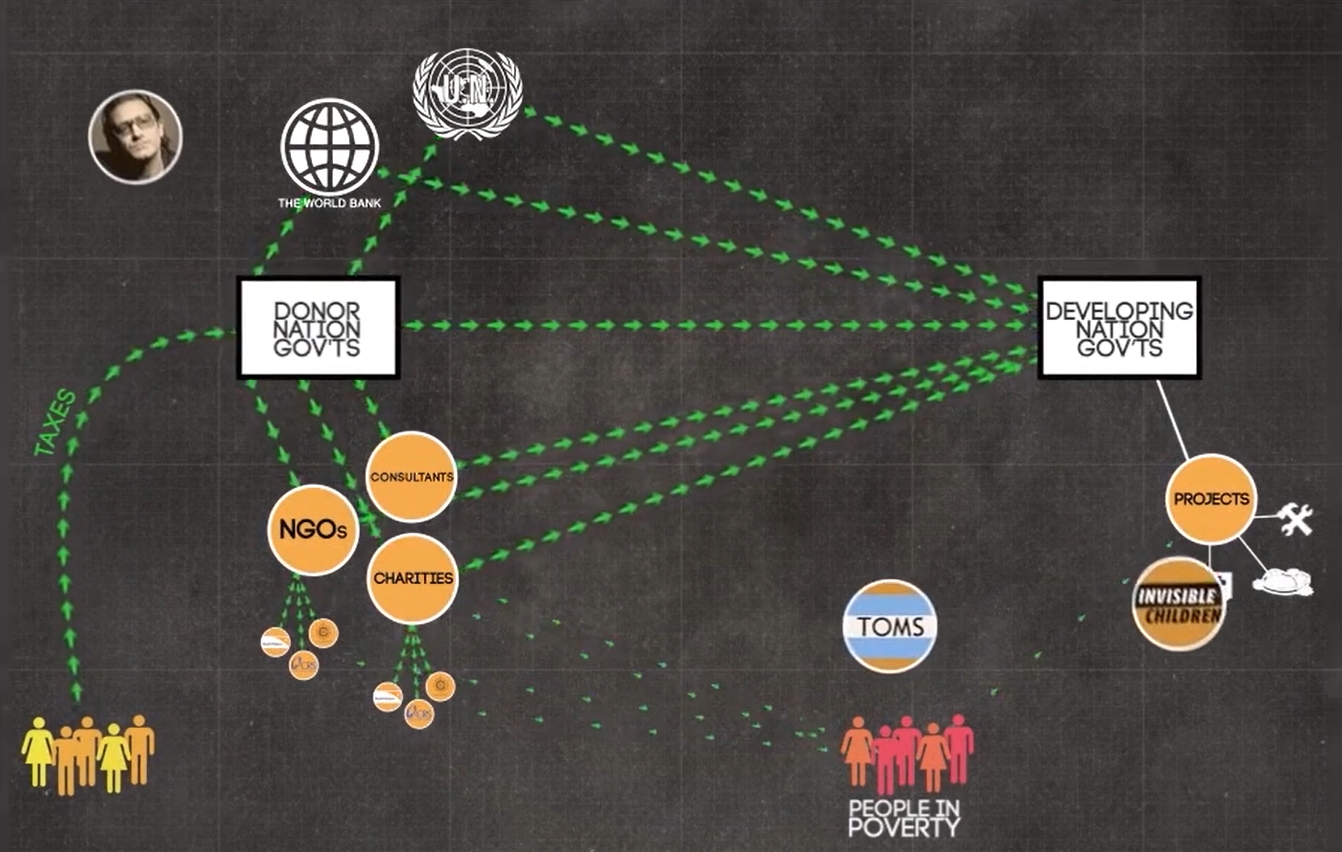
The largest NGOs receive state funding of around $500 million, with up to 75% of their budgets coming from public funds.
New Colonialism?
The success of Marshall Plan led to it being regarded as an optimal model and extended to developing countries. The idea was the assurance of infrastructure, education and electrification – so that countries might enter the industrial era. However, those were completely different times and circumstances.
Meanwhile, that model of aid to Africa has turned into the lifestyle, almost an “aid industry”, which lasts decades and prolongs dictator’s power.
By contrast the aid system, which ties countries into a chain of IMF loans and World Bank, only entrenches poverty – says the Bishop John Rucyahana of Rwanda in the film. – That kind of help, in his view is a new form of colonialism.
2. Because handing out finished products is not a solution.
The old aid system, based on distributing aid, is referred to in the film as “Paternalism”. Or colonialism or even, neo-colonialism, orneo-neocolonialism. “The rich treat the poor patronizingly, and the poor feel resentment toward the rich” – we hear as a summary of relations in the world of humanitarian aid.”
Countries that are called “poor” are, in fact, rich in oil, diamonds, timber, gold and land. Africa has always been the reservoir of resources for the world.
No country has ever developed through aid.
“I do not know a single country, that has flourished with the help of charity. This path leads nowhere. Countries develop through trade, innovations and business.” – says Ghanaian businessman to the camera, a succesfull man. This is Herman Chinery-Hesse, the founder of an IT company, known as the ‘The Bill Gates of Africa”.
And he adds: “People here are not stupid, they are simply disconnected from the global trade, that’s all.

No one can compete with freed products.
3. Because handing out finished products causes harm.
This Western aid system, based on sending finished goods, is described in the film as follows: first, by tariffs and blockades, the West protects its markets and then its high-production output (thanks to donations) is sent to poor countries, where it destroys local production. Because no one stands a chance, competing with free products. – say small business owners, who were negatively affected by free aid.
This was the situation in Kenia, betweem 1980-90, when factories were massively shut down and cotton plantations collapsed after the influx of free, large-scale second-hand clothing from the West.
This was the case on Haiti after the earthquake in 2010, when rice subsidized by 35 – and in some cases even 100 – percent was shipped there from the United States, destroying local rice production. Unable to make a living, farmers moved to the cities, expanding the slums and deepening poverty.
There was nothing growing over there
4. Because this system presents and unfair image of Africa.
One of the best-selling singles in the history of British music. (It was even sold in butcher’s shops and wasn’t surpassed until more than a decade later by Elton John’s “Candle in the Wind.”) We’re talking about “Do they know it’s Christmas?”, released in 1984, a major collaboration between well-known musicians to raise money for the victims of the famine in Ethiopia. In this smash hit, we hear the following about Africa and its people:
Where nothing ever grows
No rain nor rivers flow
Do they know it’s Christmas time at all?
(The answer to this chart hit was the track “We are the world”).
Another of the “aid industry” is that it promotes a sentimental and misleading image of Africa on a Waste Land, on a massive scale and Africans as helpless and dependend.
Celebrities are not spared in the film either. They are criticized for reinforcing the harmful and misleading image of Africa as nothing more than a poor and helpless continent, and for appealing to an establishment that ultimately only perpetuates the status quo.

The film is provocative, one-note and almost cruel. It is driven by obvious bias, at times chaotic and repetitive.
The film’s main flaw lies in its absolute rejection of the idea of any form of help. The word ‘help’ itself is stigmatised 🙂. Meanwhile, we can agree with several aspects above and by understanding, how ill-considered aid can be harmful, such a radical view is difficult to agree with.
Of course, our organisation does not send, ready-made goods to Africa, nor employees instead it supports investment and local entrepreneurship. However, there are cases, when these principles must be set aside, for example: when a hospital needs to be equipped with specialised medical equipment – which has to be shipped from Europe. In general: help is a positive word unless use in a paternalistic sense.
The film is highly valuable, because it rejects rigid thinking and pokes a hornets’ nest.
In my opinion it’s worth watching and thinking about!
Poverty, Inc., directed by Michael Matheson Miller, US, 2014
2014 | Documentary | 1h 31m
Available on https://vod.greenfestival.pl/v/bieda-spolka-z-o-o,241.html?sad=441f205c312a
7/10