
“A medicine that could prevent half of all malaria-related deaths costs only 12 cents per dose.” How is it possible that “the West has spent USD 2.3 trillion on foreign aid over the past 50 years, yet has failed to provide poor children with a medicine costing just 12 cents?”
“The West has spent USD 2.3 trillion and has failed to provide poor families with a four-dollar mosquito net. The West has spent USD 2.3 trillion and has failed to allocate three dollars to every young mother in order to prevent five million deaths.”
Arrogance and Utopia
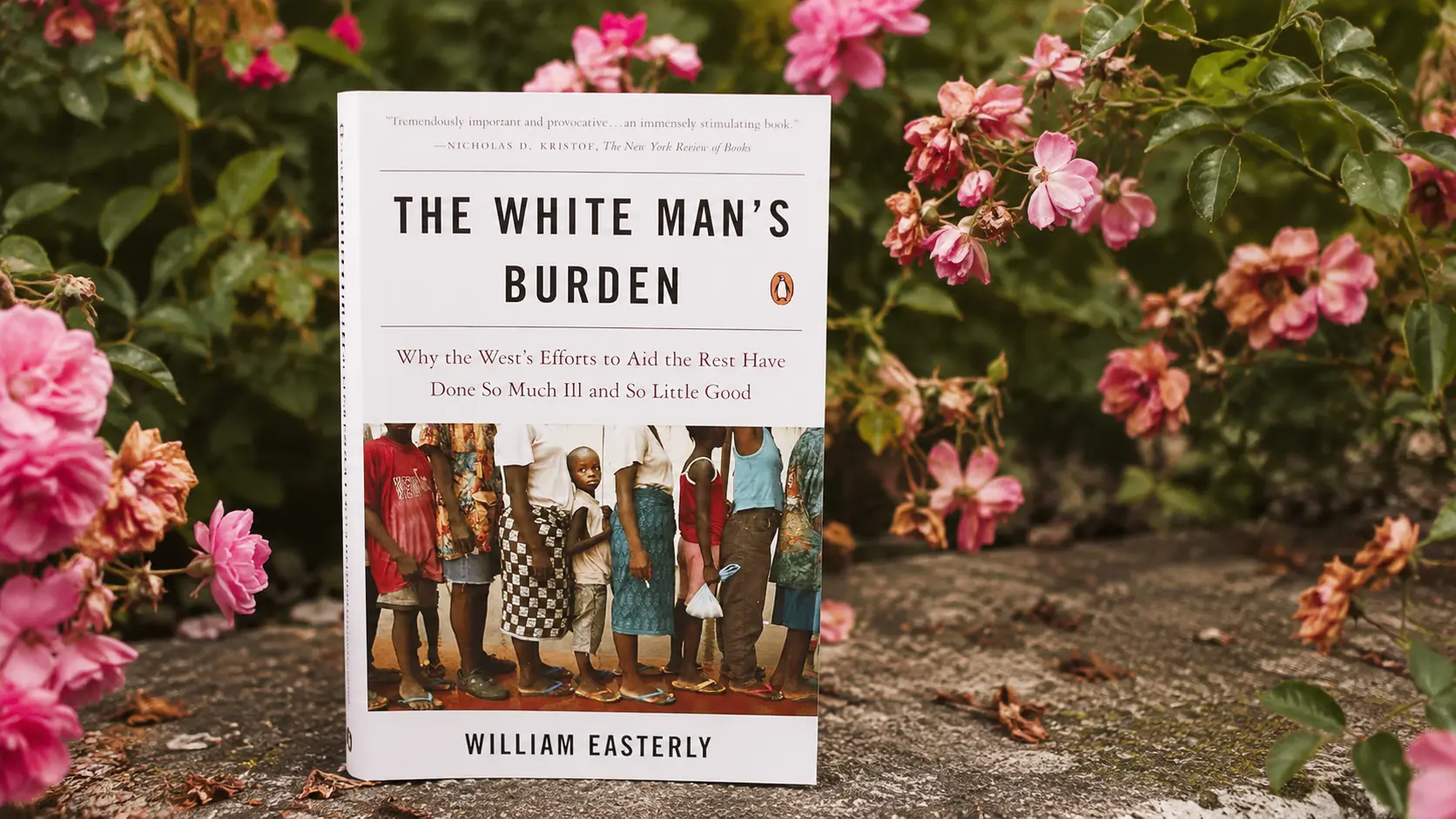
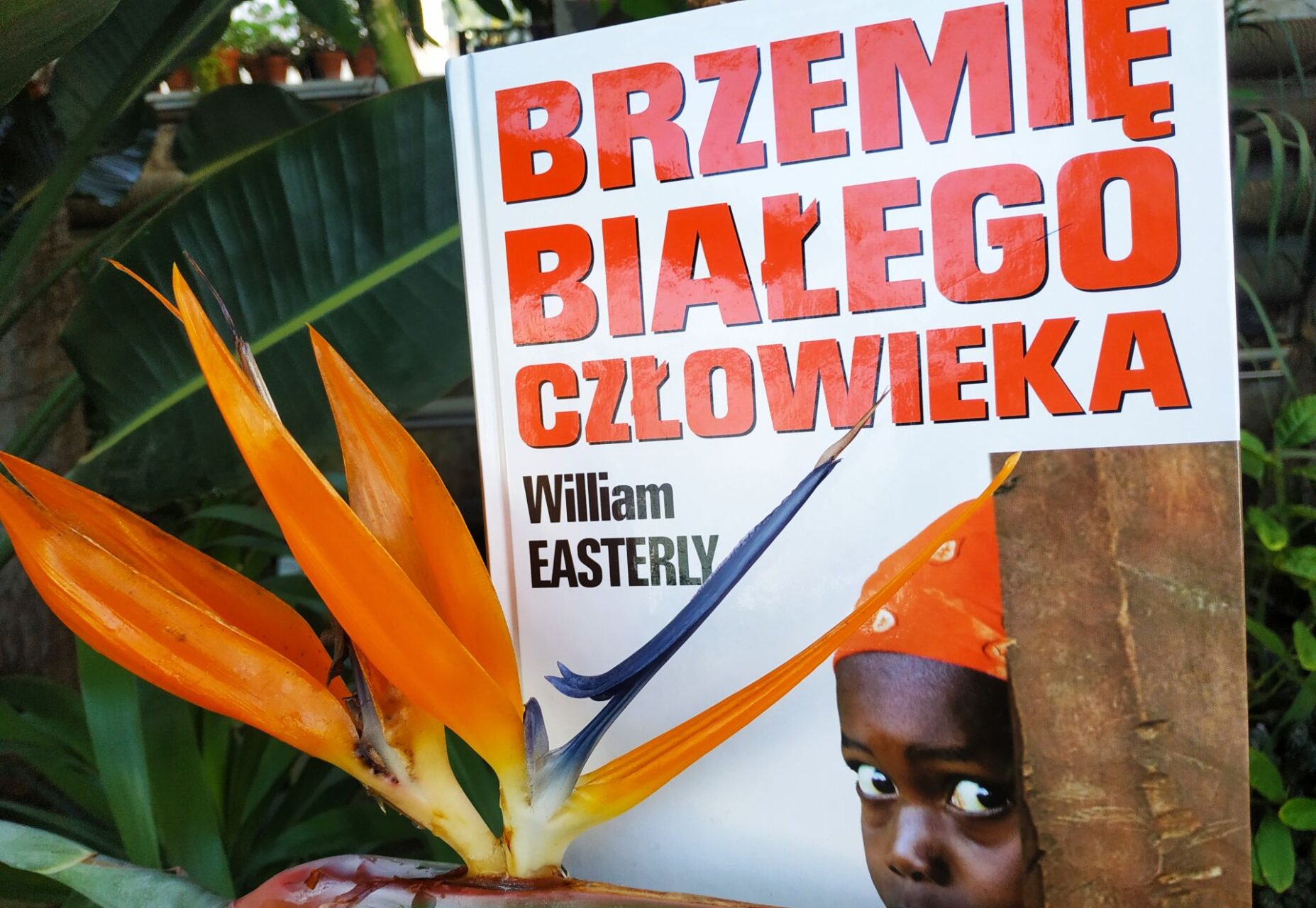
William Easterly, a professor at New York University and former World Bank economist, opens with these striking questions. He wrote a book explaining why international aid delivered by global organizations has failed to achieve its noble goals.
Easterly describes the mind set he criticizes as that of the Planner (in contrast to the more effective Searcher). The Planner’s mentality is rooted above all in arrogance: wealthy people believe they can solve the problems of poverty simply because they are wealthy. In other words, they assume that their resources, technology, funding, and expertise are sufficient to solve these problems.
The plans put forward by global institutions are grand, ambitious, and appealing. They promise to end poverty. Easterly argues, however, that this is a utopian vision, and he explains why.
It depends on us?
“Planners” are condescending. “In the very beginning of the Sachs’s book The End of Poverty, Bono said «It depends on us»”. Us – white people. The myth of The White Man’s Burden in modern version. Planners suggest their solutions on the poor’s behalf.
Planners realize their political agendas. “USAID shamelessly claims that their goal is advancing <the foreign policy objectives of the United States.>”
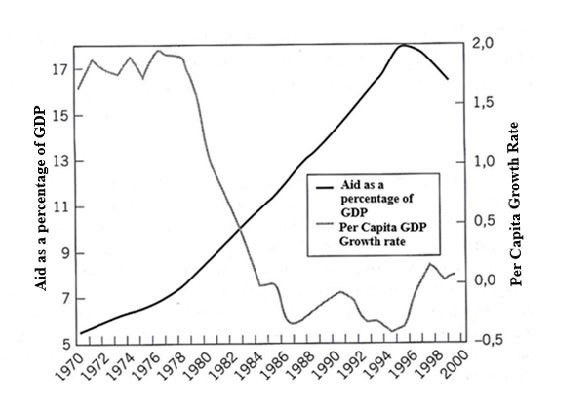
Their assumptions are false: for example the fact that “The poorest countries are allocated in the poverty trap, which they can’t escape unless, rapid financial support by an international aid” or “financial, foreign aid gives a major acceleration for countries as base for an independent growth”.
In the book we can find charts like that one:
Market can’t be planned
Another false assumption of Planners: we should implement free market. Meanwhile the author says that market cannot be planned. “Free markets work but it’s reforms do not. (…) Markets appear in an unplanned way, spontaneously, adapting to local conditions and traditions and not by some centrally planned reforms”.
Planners from USA, World Bank and IMF assume that governments of poor countries are bad and should be forced to change in exchange for help. Meanwhile the author writes: “Democracy works out but forced democracy – quite the opposite”. This is because democracy is characterized by feedback and accountability, (both of which are limited among recipients of international aid.) The way to democracy is slow and takes time. When the situation is unstable democracy turns into the tyranny of the majority. (in multi-ethnic, African countries is especially dangerous).
The oil weakens democracy
Another problem with applying changes in African countries is “the oligarchy connected with natural resources. (…) Crude oil weakens democracy and stands on its’ way. Incomes from petroleum are easy for redistribution. Thus, wealthy and well-connected insiders who benefit from oil controlled by the dictatorship stand to lose a great deal under democracy. “New democracies have succeeded in Africa primarily in resource-poor countries such as Benin, Madagascar, and Mali, whereas oil-rich countries such as Algeria, Cameroon, Gabon, and Libya continue to be ruled by dictators. On average, the world’s largest oil producers rank among the fifteen least democratic countries.”
“If it comes to promoting democracy, one of the researches on building statehood by Americans, says it didn’t work out. Scientists (…) analysed 16 American efforts on building democracy, in the previous millennium. Only 4 countries remained democracies ten years after Americans left – Japan and Germany after their defeat and occupation during the Second World War, as well as with the small states of Grenada (1983) and Panama (1989). A similar analysis was conducted to assess the effectiveness of UN peacekeeping operations by asking whether peace had been maintained for ten years after the intervention. UN interventions resulted in lasting peace in only one quarter of the cases. Without UN intervention, lasting peace was achieved in half of the cases.”
Wsparcie podejrzanych rządów
The Planners help wrong governments. IMF , World Bank, GB and USA “has decided to help implement solutions but only through the governments of aid-recipient countries. If, all poor countries really have bad governments, agencies will offer help to poorly governed countries. The other issue is foreign aid, used as a political reward for allied governments regardless of how suspicious they can be(…) In that way 25 most non-democratic governments (from 199 ranked by World Bank, by how democratic they are) received 9 billion USD of foreign aid in 2002. (…) What, then, are the chances that these billions will actually reach the poor? Despite these sobering figures, donors continue to make government transformation one of their primary objectives.
The other problem is that “systematic evidence from several recent studies suggests that aid actually undermines democracy and worsens the quality of governance.” Stave Knack from World Bank claims that higher help worsens the quality of bureaucracy and leads to an unpunished law breaking and higher corruption”. “Nowadays system of foreign aid spoils (and probably worsens) bad rules. (…) The interpretation of evidences (…) suggests that, in order to step back from obsessive actions through governance”. It does not change the fact that, the author thinks of big infrastructural investments should be executed in this way.
Don’t lose hope
Now the author screams: “Do not lose hope”. After all “The World Bank’s files contain successful projects”. Writing about a good outcomes of many decades of international help for Africa, the author points out on improvements in infant mortality rates or school enrolment rates.
It doesn’t work when you tell the poor what to do
What solutions does Easterly propose in response to the above criticism of international aid?
“A large part of the problem probably stems from the governments of wealthy countries that dictate what aid agencies should do. Dear donors from wealthy countries, please abandon your utopian fantasies about reforming the Rest. Stop rewarding aid agencies for setting politically attractive goals that are impossible to achieve. Instead, instruct them to focus on limited but solvable problems. For example, allow them to concentrate on health, education, electrification, water supply, and incremental policy reforms that promote the private sector—areas in which aid agencies have already achieved some success.”
“It does not work to tell poor people what they should do. Instead, look to aid recipients to identify those who appear willing to act in their own self-interest, provide them with incentives and opportunities to improve their lives, and trust them to take responsibility for themselves, without continuing to pull the strings.”

“Finally, the poorest should be provided with health care, nutrition, education, and other resources that enable them to benefit from their own efforts to improve their lives.”
***
Kind of off-topic but the most interesting author’s thoughts about the effects of colonialism are the following: “In 1930, in Tanganyika, colonisers implemented the rule that <every African belongs to a certain tribe, such as every European belongs to a nation.> Officials said: <Each one of the tribes must be an independent unit… every tribe must have their leader>”. Implementing both the tribal identity and artificially forced power structure, in many countries turned out to be a disaster.
Complicated straight-line borders
“What is interesting is that successful countries of East Asia such as: China, Japan, Korea, Taiwan, Thailand – has never been colonised by Europeans”> Among countries, that have never been colonies, the author notices visible differences in development of school education and economy. He sees them among different colonies. Between where white people settled and those unsettled (the last ones improved better.) Finally, he mentions his researches about arbitrary settling borders by Europeans (straight-up lines on a map, that ignore the history of those places, as well as their culture and economy.) “We came to the conclusion that artificially set up borders brings less democracy, higher mortality rate of infants, higher illiteracy, less child’s vaccination, less access to clean water.

William Easterly, The White Man’s Burden: Why the West’s Efforts to Aid the Rest Have Done So Much Ill and So Little Good, PWN, Warsaw, 2008
8/102
1“IMF gave Mobutu eleven loans during his presidential term. It’s not as though no one knew he was stealing. IMF sent German banker Erwin Blumenthal to Central Bank in Zaire, in years between 1978-79. They precisely documented how much Mobutu has stolen and presented those data to IMF and World Bank. (…) Overall, the country received 20 billions dollars in foreign aid during Mobutu’s tenure.”
2The book is uniquely rich in facts and claims. This post is only a small excerpt from the book – (I have highlighted only those ideas and findings that I found particularly interesting, inevitably oversimplifying the author’s argument.)