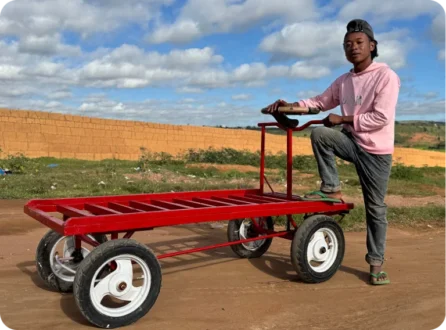

The World Bank mentions „the poor and marginalized people” as a group of „stakeholders” taking part in a major international aid project. Is this some kind of a joke, do they mean what they say? Do native Africans have anything to say in the matter?
When we read grandiose words of global aid organizations, it’s hard not to be struck by their utter naivety. The European Federation of CONCORD wrote: “We want 2015 to be a year in which all humanity unites in an unprecedented way, in order to pursue the goals of humanitarian development, gender equality and ecological justice…”
Hmmm. Ideals are noble.
Meanwhile in his book “Eksperymenty na biednych. Politiczny, moralny i ekonomiczny spór o to, jak pomagać skutecznie” (‘Experiments on the Poor: The Political, Moral, and Economic Debate Over How to Help Effectively’) by Adam Leszczyński, exposes what lies behind these ideals and also about what some people begun to openly call the “aid industry”.
It must be admitted that institutions such as UN or World Bank are the easiest targets for criticism. The book by Leszczyński goes beyond cliches, because the author presents many, contrasting points of view. He preserves, his own diplomatic restrain and leaves the judgement to the reader. It makes, the book difficult to read and appears chaotic at times. I have chosen a few topics from this tangled web (I would like to emphasize that those are not Leszczyński’s own views, but merely lines of arguments that he quotes.)

“Over the course of sixty years, more than a trillion dollars flowed into Africa.” [Foreign interventions] “may help in the short term, but at the same time they undermine all the fragile seeds of spontaneous development that already exist locally. (…) Those African countries that were the largest recipients of aid experienced negative growth for decades – an average of -0.2 per cent of GDP per capita per year. (…) Zambia, one of the richest countries in Africa in 1964 and also a major recipient of development aid over the following three decades, systematically grew poorer from one decade to the next.”
Why is this form of help not effective enough?
International help – or else: richer countries are faced with a number of accusations against them.
Governmental help: ineffective
“Developmental help accounts for 13 percent of the GDP of an average sub-Saharan African country and often majority of governments budgets. Governments have little to no motivation, to answer citizens questions and build well-functioning tax systems” – says Dambisa Moyo, an American economist, born in Zambia. Her point is that developmental aid raises corruption. “In majority of the poorest countries both government and citizens are – paradoxically – interested in keeping the system, in which, economy is impossible to improve. Rulers live from various type of governmental rent: corruption, political patronage and pulling a few strings for governmental contracts.”

Beyond the reach of those concerned
Charity projects of international institutions “are usually organized behind closed doors (…) and collide with rationality of those meant to help – specifically, what they think they need.” There is more, we have examples of forced help, against local people’s will for example “Resettlement programme of 1,5 million of people from Gambelia region (borderlands of Ethiopia and Sudan) to the specific villages. It was financed, mostly by British and American tax payer and World Bank. (…) The Army of Ethiopia committed relocations and killed several villagers, who resisted. Despite human rights violation has been described by bigger international organisations (this topic has been published in a special report on Human Rights Watch), World Bank representatives claimed to know nothing about any violations.”
Help for… corporations
“Thousands of jobs in first world countries are dependent on developmental aid. (…) Thirty out of fifty main clients of north-American corporations (…), which deal with farming, those countries benefit the most from aid” – writes Arturo Escobar, Columbian anthropologist. “This is not a coincidence. Quite the opposite, one of the main roles of developmental aid is creating trading opportunities in the interests of the first world elite.”
Resource Drain
“Part of the problem is trading politics of rich countries, which makes export difficult for poorer countries – partly because of tariff structure (the lowest tariffs on raw materials and the highest on highly processed products).
One rule for the powerful, another for everyone else
“For the other economist, Ha-Joon Chang (..), he is a professor in Cambridge, help is an obstacle to gaining autonomy. Governments of rich countries use help and access to their internal markets as baits, in order to persuade developing countries to accept neoliberal solutions. World Bank and International Monetary Fund, are in charge of about tens of billions dollars. Meanwhile, Ha-Joon Chang informs that none of the nowadays, developed countries was following those advices. Especially, while building their own economical power. It’s quite the opposite, all those countries – from Great Britain and USA in XIX century to South Korea, between 60s and 70s – protected their own markets from import, made life native entrepreneurs easier, were running special public invests and never respected, external intellectual property. Countries were focusing on the benefits of imports – but it doesn’t mean opening their own market for outer products.
Today’s rich countries used tariff protection and subsidies, and discriminated against foreign investors — in other words, they did everything that is now considered unacceptable by economic orthodoxy and has been heavily restricted by international treaties, such as agreements under the World Trade Organization, as well as prohibited by aid agencies and financial institutions.”

What is effective then?
After a decades of organizing help, based on it’s core reasons, setting conditions under which aid must be provided: “specialists from developmental help discovered a new method: “shall we just share money equally among poor, usually setting conditions like – sending kids to school or a doctor. I am surprised, much time passed since governments and external organisations treated such ideas seriously - if we gave it a second thought. We can rationalise it with a lack of trust for beneficiaries, so a fear of wasting money by the poorest, by drinking, gambling or spent on luxury items.”
Aid does not shrink the will to work
Meanwhile “In 2015 scientists from J-PAL organisations, from Harward, has published a new results, which says the aid does not shrink the will to work – in any case it’s not what happens in poor countries. They surveyed by experimental method seven cash aid programmes (conditional and unconditional) working in six countries: Honduras, Morocco, Mexico (two programmes), Nicaragua and Philippines. Almost all of researched projects were the support for minors by their parents. (…) The influence of cash from state coffers, in all those cases totalled exactly zero.
Unconditional help
“According to recently published unconditional financial aid programmes exist in 119 developing countries, in 52 of them work unconditional aid programmes.
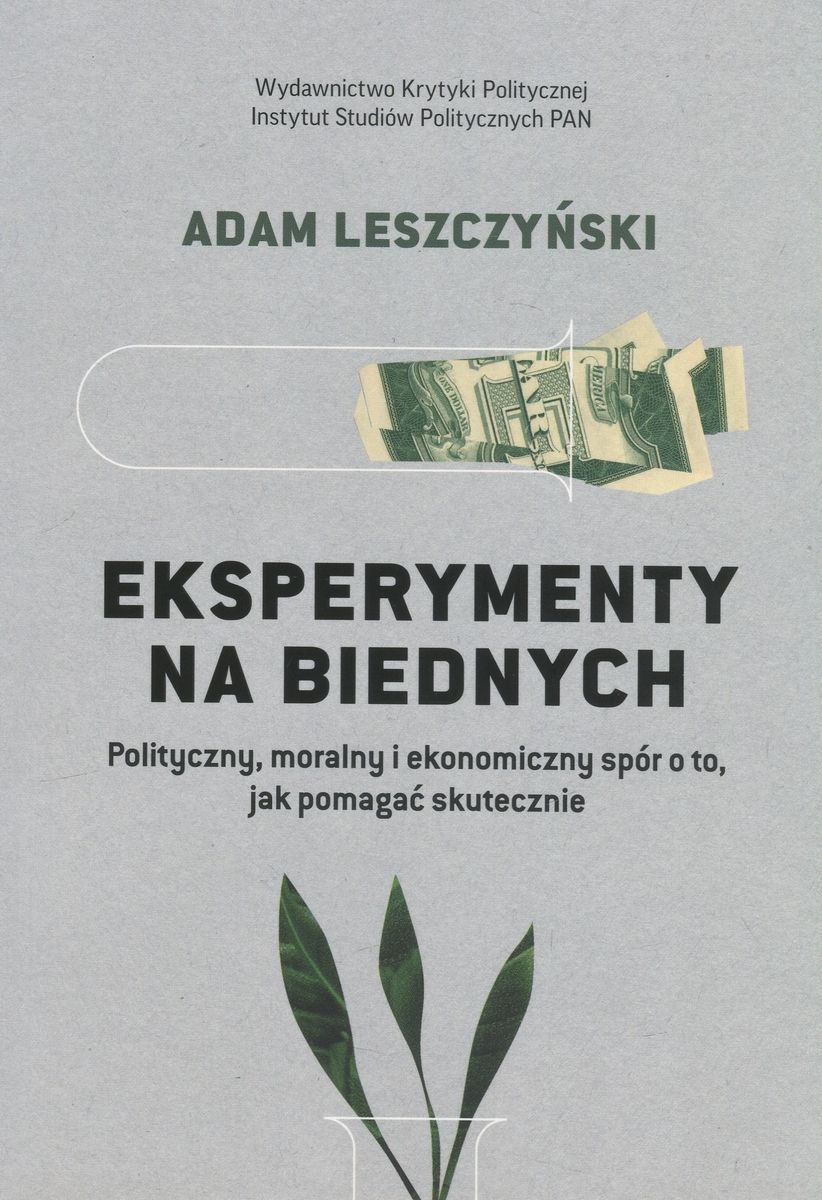
“Average African does not need help but job” – at the very end, instead of summarizing (which does not exist in Leszczyński’s book) there is a quote of Owen Barden, one of the most famous economists, specializing in developmental issues.
Adam Leszczyński, Eksperymenty na biednych. Polityczny, moralny i ekonomiczny spór o to, jak pomagać skutecznie, Wydawnictwo Krytyki Politycznej i Instytut Studiów Politycznych PAN, Warszawa, 2016 (Experiments on the Poor: The Political, Moral, and Economic Debate Over How to Help Effectively, Wydawnictwo Krytyki Politycznej and the Institute of Political Studies of the Polish Academy of Sciences, Warsaw, 2016)
6/10